

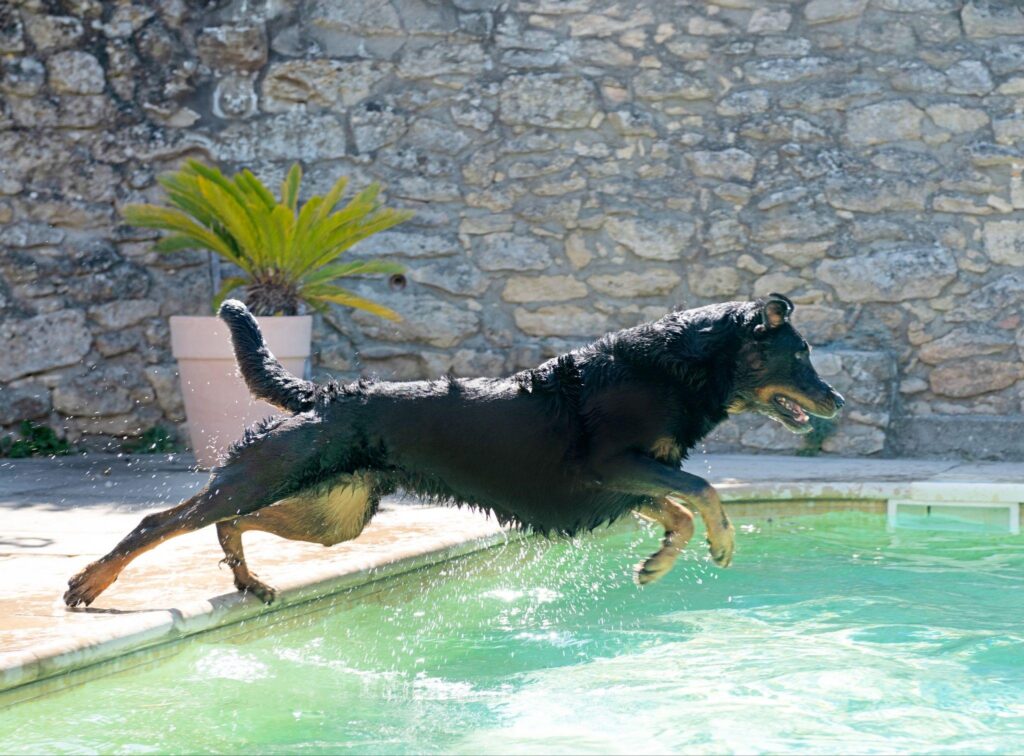
Field notes from Laszlo and Martina Pek Mrazovac, FCI Golden Crown Master Trainers at Apex Force K9 | Elite Protection Dogs — Dallas–Fort Worth, Texas
For today’s executives, entrepreneurs, family offices, and high-net-worth families, security stopped living at a single address a long time ago. A modern principal might wake up at a primary residence, take a call from a corporate office, board a private aircraft by midday, and check into a luxury hotel in another state — or another country — by nightfall.
A world-class alarm system protects the house. It does not protect the person who just left it.
That gap is exactly why a growing number of our clients now travel with a professionally trained executive protection dog. At Apex Force K9 | Elite Protection Dogs, based in Dallas–Fort Worth and placing dogs nationwide, the most consistent shift we have watched over the past decade is this: for many principals, the greatest vulnerability is no longer at home. It is in the space between destinations.
Six Decades of Working Dogs Behind Every Placement
Before we explain why dogs outperform fixed security on the move, it is fair to ask why anyone should take our word for it.
The Pek Mrazovac family has bred, evaluated, and developed working dogs continuously since 1962 — three generations, across Europe and the United States. Martina Pek Mrazovac is a third-generation trainer and an FCI Golden Crown Master Trainer, the highest distinction within the International Cynological Federation system, recognized across more than ninety countries and held by very few trainers in America. Laszlo Pek Mrazovac has spent more than twenty-five years developing protection dogs, family protection dogs, and service dogs for private clients, families, and operational handlers.
That background matters for one reason: almost everything that makes an executive protection dog difficult to produce has nothing to do with bite work. It has to do with behavior in the real world — and real-world behavior is something you only learn by putting thousands of dogs into thousands of real situations.
The Real Problem: Transitional Vulnerability
Most luxury residences are already well protected — surveillance, controlled access, on-site personnel, perimeter coverage. The problem is that all of it stays behind the moment the principal walks out the door.
In our experience, the highest-risk moments for the clients we serve are almost never inside the secured home. They happen during transitions:
• The walk from the residence to the vehicle
• Curbside at a private aviation terminal
• Arrival and check-in at an unfamiliar hotel
• Moving through a crowded international airport
• A public event, gala, or conference
• Any unfamiliar city where local patterns are unknown
Security professionals call these transitional vulnerabilities. They share one trait: they all involve movement, and fixed security cannot move. A trained protection dog can. Protection that travels with the principal is the entire point.
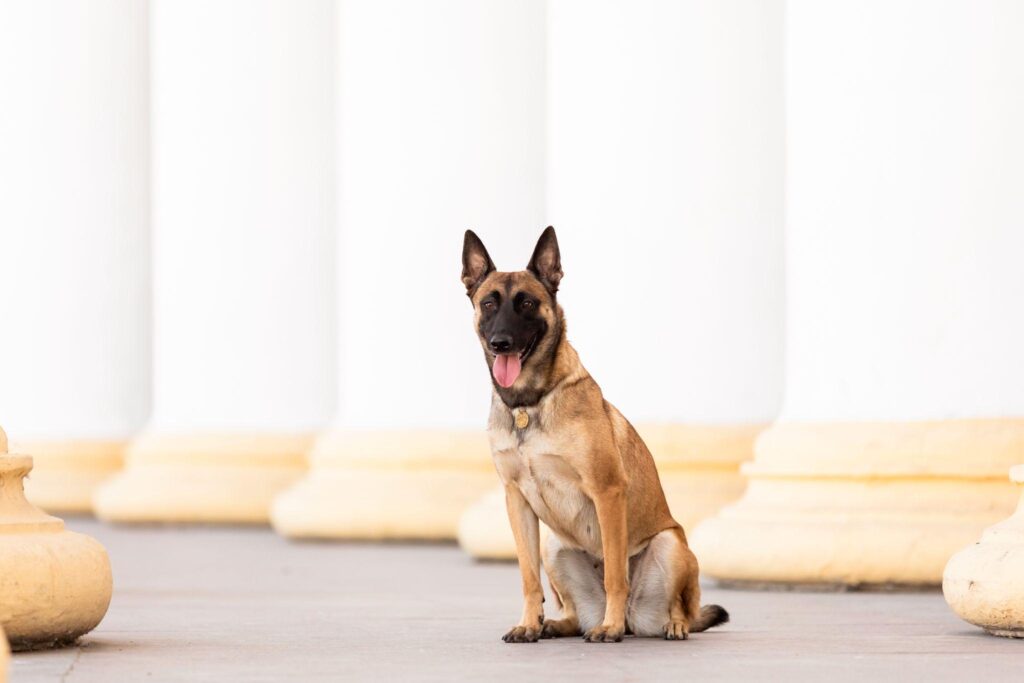
Why Executives Choose a Dog — Not Just Another Camera
Clients rarely choose a protection dog because they are afraid. They choose one because they have thought the problem through. Three advantages come up again and again.
It never goes offline
A camera records. An alarm reacts after a trigger. A trained dog is awake to its environment the entire time it is beside you — in the elevator, in the car, in the lobby — reading behavior and proximity continuously, with no blind spots and no standby mode.
Presence is prevention
The most valuable thing a well-developed dog does is the thing that never makes the news: it discourages a problem before it starts. A composed, obviously trained dog at a principal’s side changes the calculation for anyone looking for an easy opportunity. For an executive, the situation you prevent is always cheaper than the one you manage.
Capability held in reserve
If a genuine threat does materialize, a finished dog can respond decisively — and, just as importantly, stop on command. Deterrence, mobility, and controlled response in a single companion is a combination no device replicates.
What an Executive Protection Dog Actually Does on the Road
This is where most protection-dog articles stop short. Anyone can describe what a German Shepherd is. Far fewer people can tell you how a finished dog behaves at the bottom of a jet’s airstair, in a five-star lobby at check-in, or in the back of a chauffeured SUV at the end of a fourteen-hour travel day. That is the part that actually matters, so here is what we condition our dogs to do.
At the private aviation terminal
Turbines, ground crew, baggage carts, and a hard ramp surface are a lot of novelty at once. A travel-ready dog walks the ramp without flinching, boards on command, settles in the cabin, and stays down for the flight. It treats the aircraft as just another room.
In the hotel lobby
A luxury lobby is full of triggers — bellhops, rolling luggage, children, other guests’ dogs. The right dog reads the room and stays neutral. It does not greet strangers, does not pull toward distractions, and gives no one a reason to look twice. Discretion is the job.
In the chauffeured vehicle
The dog loads and unloads cleanly, holds a settled position on long drives, and stays composed through traffic, valet hand-offs, and the constant in-and-out of a working travel day — never underfoot at the exact moment the principal needs to move quickly.
In the crowded international airport
Dense crowds, PA announcements, customs lines, unfamiliar smells and languages. A finished dog moves with its handler through all of it without fixating, reacting, or drawing a crowd of its own. It stays effectively invisible — present, aware, unbothered.
In the boardroom or at the event
In a meeting or a formal event, the dog holds a quiet down for hours, ignores food service and side conversation, and remains a non-event in the room — exactly as it should be.
The thread running through all of it is the same: the dog stays unnoticed until the instant it is needed. That is the real standard, and it is far rarer than a flashy demonstration on a training field.
What Most People Get Wrong About Protection Training
A common assumption is that the hardest part of this work is teaching a dog to engage. In our experience, the opposite is true.
The hardest part of protection training isn’t teaching a dog to bite. It’s teaching a dog when not to. A dog that reacts to everything can’t be trusted in a hotel lobby — and a hotel lobby is where these dogs actually live.
— Martina Pek Mrazovac
An executive-level dog spends far more of its development on environmental neutrality, impulse control, social stability, obedience, and decision-making than on protection exercises. The goal was never aggression. The goal is controlled judgment.
Why Most Dogs Never Reach Executive Level
Plenty of dogs can look impressive in a controlled demo. Very few can accompany a principal through a private terminal, a hotel, a chauffeured car, a conference, and a packed airport — and stay calm, neutral, and unobtrusive the whole way.
If people notice the dog before they notice the client, the dog is doing the job wrong. The best ones disappear into the background until the moment they’re needed.
— Laszlo Pek Mrazovac
That standard is why a true executive protection dog is defined not by how it engages a threat, but by how completely it blends into an environment until it has to act.
Choosing the Right Breed
A handful of breeds consistently excel in this work, and at Apex Force K9 every dog comes from proven European working bloodlines.
German Shepherd protection dogs
German Shepherds remain one of the most versatile executive and family protection breeds in the world — intelligent, adaptable, and balanced in temperament, which is exactly what travel demands.
Belgian Malinois protection dogs
The Belgian Malinois is prized for its drive, athleticism, and trainability. It is the choice when responsiveness and work ethic are the priority, and it thrives with an experienced, active handler.
Doberman protection dogs
The Doberman pairs intelligence and athleticism with a refined, elegant presence and strong handler focus — a combination many executive clients prefer for its discretion.
A note we give every client, though: breed is not the deciding factor. Temperament, genetics, environmental conditioning, and professional development matter far more than the name of the breed.
How These Dogs Are Built — and Delivered
Every dog we place undergoes twelve to twenty-four months of structured development built around real environments — homes, vehicles, travel, and public settings — not sport routines or competition rings. Selection comes first, because a training program can only develop genetics that already exist; it cannot create them.
Placement is just as deliberate. We start with a consultation about your lifestyle, household, and travel patterns, match you to specific dogs by temperament rather than inventory, and then personally deliver your dog nationwide with hands-on handler instruction so it integrates cleanly into your routine. You can view available protection dogs or start with the matching questionnaire.
Final Thoughts
As executive travel keeps getting more mobile, more principals are looking for security that moves with them instead of staying bolted to one property. A professionally developed executive protection dog offers a combination — companionship, mobility, deterrence, and genuine protection — that no fixed system can match.
Developed correctly, the dog should enhance a principal’s lifestyle, never dominate it. That has been the Pek Mrazovac philosophy since 1962, and it still defines every dog that leaves our program today.
About the Authors
Laszlo and Martina Pek Mrazovac lead Apex Force K9 | Elite Protection Dogs in Dallas–Fort Worth, Texas. Both are FCI Golden Crown Master Trainers, continuing a family working-dog tradition that began in 1962. They develop German Shepherds, Dobermans, and Belgian Malinois from European bloodlines for families, executives, and estates nationwide.
Frequently Asked Questions
Can protection dogs travel on private jets?
Yes. A properly conditioned executive protection dog boards and settles on private aircraft without issue once it has been acclimated to aviation environments.
Are executive protection dogs allowed in luxury hotels?
A finished dog is trained to stay calm, neutral, and unobtrusive in hospitality settings. Individual hotel pet policies still apply and should be confirmed in advance.
What separates an executive protection dog from a standard protection dog?
Extensive environmental conditioning, socialization, impulse control, and real-world exposure — well beyond basic protection work.
Which breed is best for executive protection?
German Shepherds, Belgian Malinois, and Dobermans are the most common choices, but temperament and training quality matter more than breed.
Where is Elite Protection Dogs based, and do you deliver?
We are based in the Dallas–Fort Worth area and deliver nationwide, with hands-on handler instruction included.