
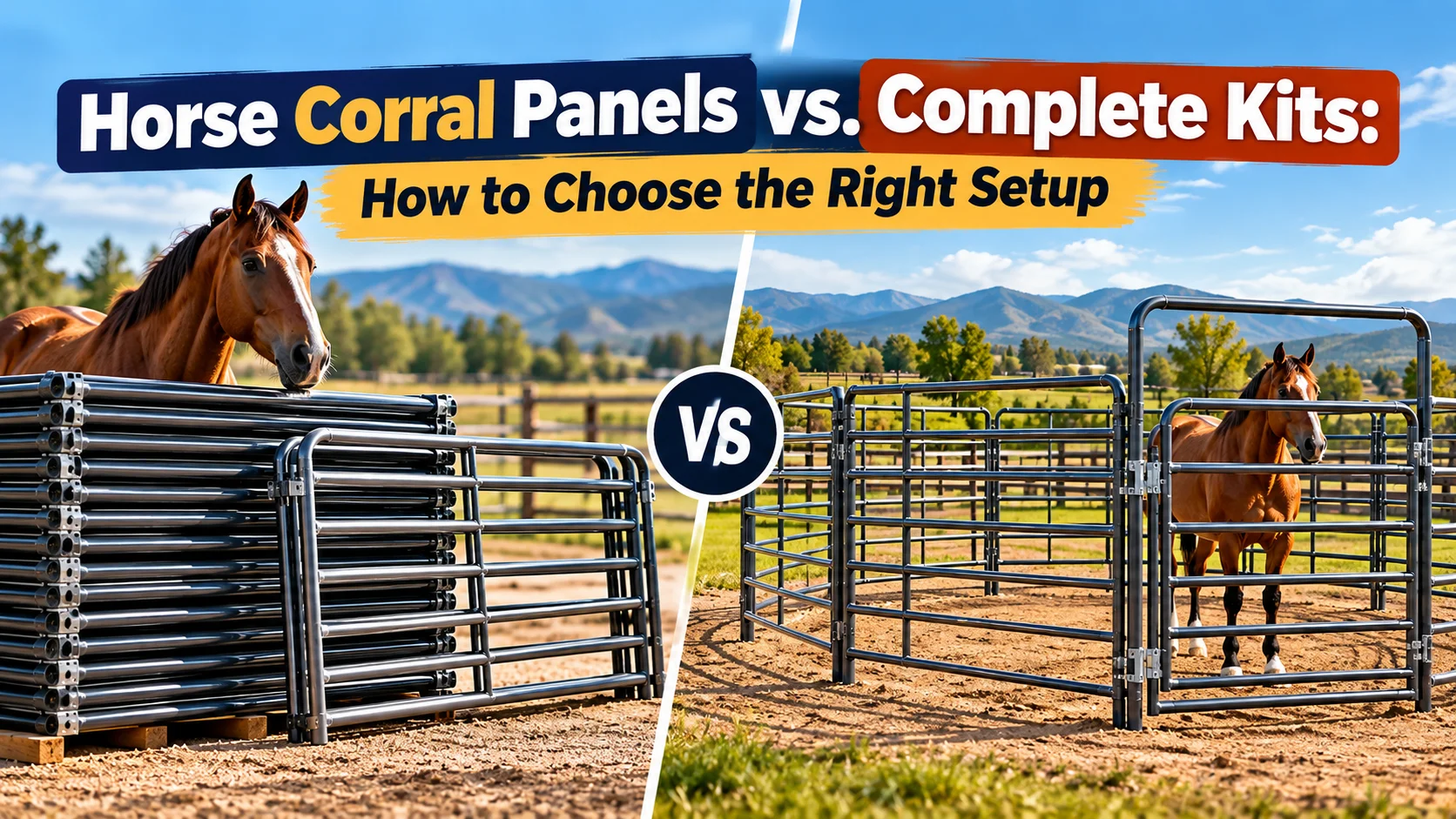
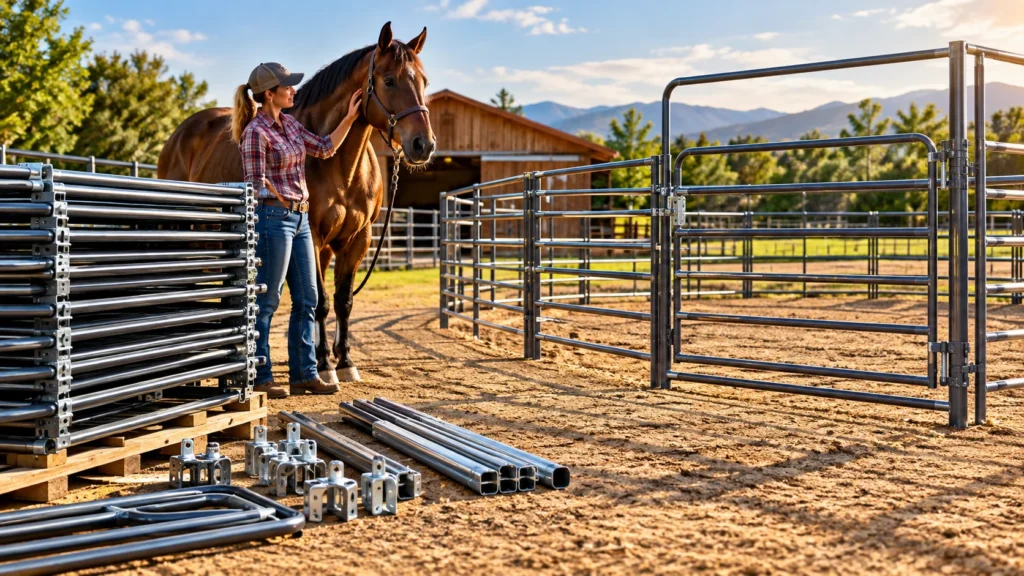
When buying a first corral, it is easy to focus on the advertised price. The more useful starting point is how the enclosure will fit your property and daily routine. A complete kit and a set of individual panels can both be worth considering, but compare what each actually includes before choosing.
What actually separates a kit from a modular system
A complete corral kit bundles panels and access components into one order. Check the listing for the number of panels, gates, posts and fittings rather than assuming they all come as standard. Ask for assembly instructions and a layout drawing before ordering, so you can compare the proposed footprint with the space you have available.
A modular panel system is much different. You choose what length each panel is, what width your gate will be, and where you want your gate. You also design the actual footprint of your corral based on your site, not on the idea of the rectangle in the center of your barn. It takes more planning up front, but it also means the corral you end up with actually fits your barn, your slope, and your schedule rather than making you fit into the corral.
Why the price-per-kit comparison is misleading
Kit prices may appear cheaper since it’s easy to compare the sticker price, but two kits at the same price point may utilize completely different steel gauges, gate widths, and post materials. A kit made from thin tubing with a narrow gate is not the same product as one made from heavy welded panels with a nine or ten-foot opening, even if they cost the same.
Freight belongs in the comparison too. Request a delivery quote for your address and check what unloading arrangements you need. Before assuming a kit is the better deal, compare the steel gauge, gate dimensions, post specifications and delivered price. Two packages with similar listing prices may leave you with quite different installation jobs.
Steel gauge is not a spec you can skip past
Do not judge suitability from the way a panel connects alone. Ask whether the particular product is intended for temporary handling or permanent horse containment, and what installation it requires. Horses can put pressure on fences and gates, so inspect the whole construction rather than assuming a portable panel or a welded one is automatically suitable. A bent panel or loose connection deserves attention before the enclosure goes into use.
Welded 14-gauge steel is one specification to compare, not a universal guarantee of suitability. Look at the panel design, welds, connections and intended use alongside the tubing gauge. Ask how the finish should be maintained and what to do if it is damaged. Whether you are comparing powder-coated or galvanized options, judge the complete product and its care instructions rather than expecting the finish alone to settle the decision.
Where fixed kits fall apart on real properties
A prefabricated kit offers a defined layout, which may or may not work around an existing barn door, water line, manure route or shelter. Before ordering, mark out its proposed footprint. Check whether the access points and panel lengths work with the shade, drainage and daily movements you already need to accommodate.
If the proposed layout does not fit, compare the cost and practicality of adapting it with buying panels separately. A U.S.-based manufacturer such as Blacktail Corrals offers a starting point for looking at welded 14-gauge steel livestock equipment. Check the available dimensions and compatibility before assuming any range will suit a custom footprint or connect to the panels you already own.
Gate placement is a bigger deal than it looks
Check whether a kit limits the number or position of its gates. This is not a problem if your only purpose is to walk horses in and out. However, it becomes a problem if you’ll be backing a trailer up to load, having feed delivered from a truck, or needing a second access location for daily handling on the far side of the pen. If you put the gate in the wrong place, you will be walking horses across the entire footprint every time you do a thirty-second task.
A simple rule of thumb
If your proposed corral is permanent, your site is flat and unobstructed, and you do not expect to expand it, a complete kit may be a straightforward choice. First confirm that the design is intended for that use and that its gate arrangement works for your animals, equipment and daily access needs.
If you expect to add a round pen, extend an alleyway or change the layout as your herd changes, compare modular options carefully. Check which panels and fittings can be reused and what an extension would involve. The extra planning is worthwhile when it helps you choose an enclosure you can actually adapt, rather than assuming either format is flexible by definition.