
What causes the most panic among sick-fish hobbyists is giving the wrong diagnosis, not treatment. Bacterial infections mutate, meaning that if you incorrectly ID a bacteria and give an antibiotic it’s not sensitive to, it’ll come back in a form that is resistant to what you are treating with. If you ID it correctly the first time and treat with the proper antibiotic, you can usually clear up the infection in one round.
Fin rot: the one everyone sees eventually
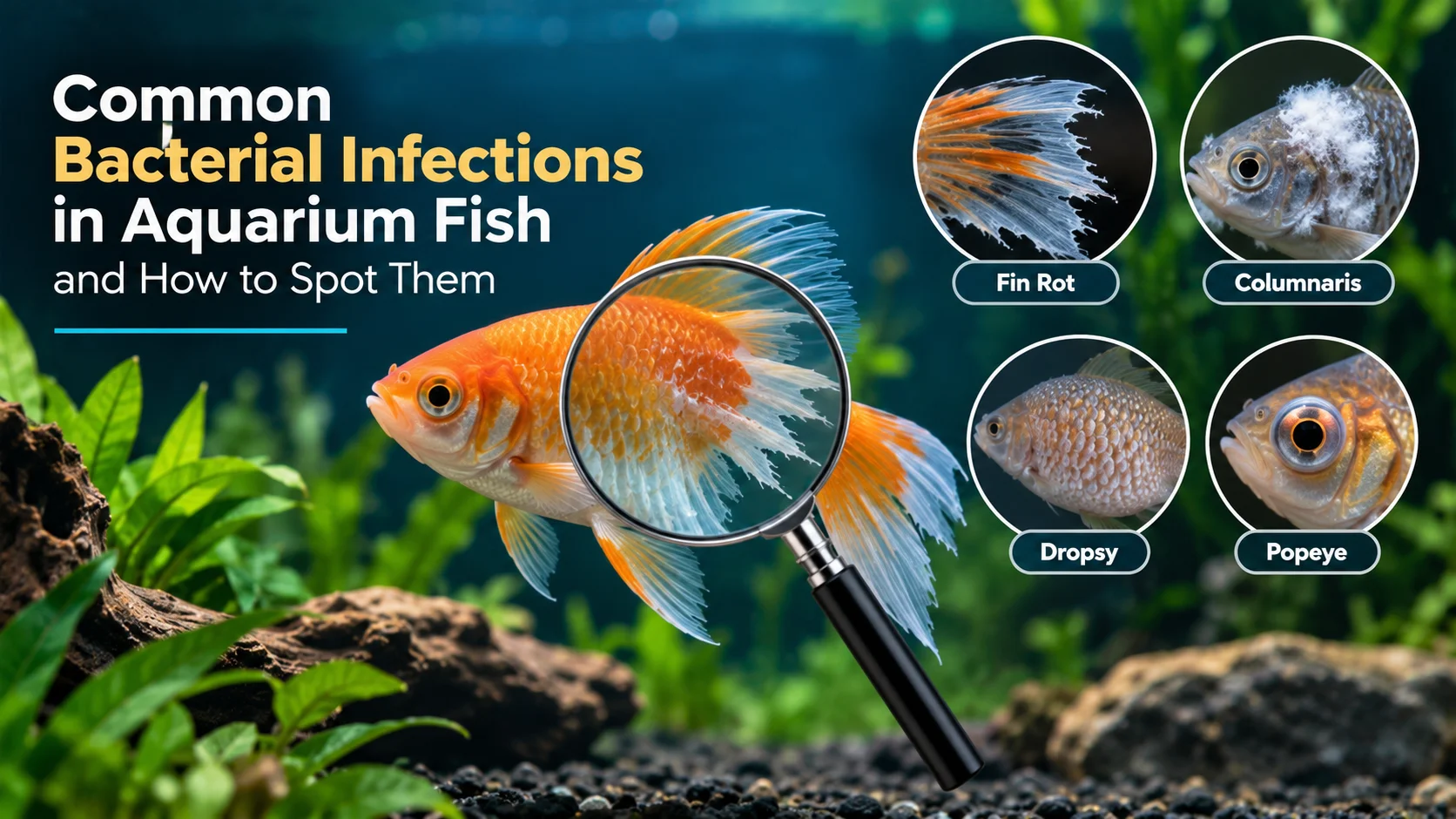
The first infection many tank owners run up against is fin rot. The edges of the fins turn white or gray and then fray and recede back toward the body. It is typically related to the bacteria _Aeromonas_ or _Pseudomonas_, both of which are opportunistic, and take advantage of a fish that is already weak from poor water or stress.
Early fin rot can be very subtle, as it may look like ordinary wear and tear. The real clue is whether it is progressive – if that fin margin is continuing to recede over the course of a few days, then it isn’t cosmetic damage from a tank mate nipping at fins. Treat fin rot as it reaches the fin base and begins to eat into the body, and your fish will have a good chance of recovery. Leave it until it’s already in the body, and they have virtually none. So catch it while it is still just fin tissue.
Columnaris: the impostor disease
Many fishkeepers erroneously diagnose Columnaris as a fungal infection. The gray-white, cotton-like patches on the skin, mouth, or fins do look similar to a fungal infection but Columnaris is not a fungus. It is a bacterial infection caused by Flavobacterium columnare which proliferates in warm, organic-laden water.
Why does this mistaken diagnosis matter? Because Columnaris can kill a fish within 72 hours of the first symptoms appearing. If you miss that short time frame by treating for fungus, you’ve missed the best chance to save the fish. If you see cotton-like lesions and the fish is obviously and quickly declining, treat as if bacterial from day one.
Dropsy: the pinecone warning sign
Dropsy is not a standalone disease. Rather, it is a symptom of advanced Aeromonas infection occurring within the body of the fish past the point including the fins and skin. This happens when fluid accumulates in the body cavity and the scales of the fish stand out from the body in a way resembling a pinecone.
Popeye: often a water problem wearing a disease costume
Exophthalmia, or popeye, is the condition where one or both eyes are protruding from the eye socket. While it can be a primary bacterial infection, more often it’s a secondary symptom that the immune defenses have failed and water quality has already deteriorated.
So if you do see a popeye, don’t just go treating the eye. Test the water first, as elevated ammonia or nitrite is frequently the actual root cause and the eye swelling is downstream of that.
Why bacteria show up in the first place
Almost all bacterial infections can be traced back to a form of environmental stress. Ammonia spikes, high nitrites, sudden temperature swings, or overcrowding all damage the fish’s slime coat, the first point of defense against bacterial invasion. Once that coat is compromised, gram-negative bacteria like _Aeromonas_ and _Pseudomonas_ that are already present in the tank get a foothold.
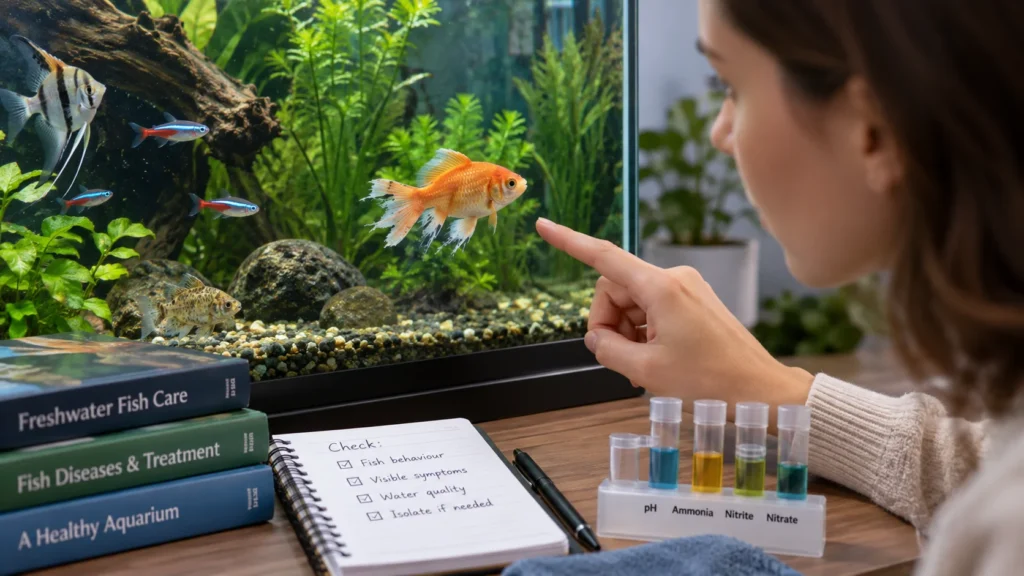
Estimates of the role of poor water quality in disease outbreaks in aquarium fish range as high as 80 percent (widely cited across fishkeeping and veterinary resources). That’s why water testing kits should be the first tool you reach for, not the last. Medicating a fish while ammonia is still climbing is treating the symptom while ignoring the cause.
Getting the treatment sequence right
Once you have deduced that the symptoms are caused by bacteria, what you do next can affect the organisms in your tank. If possible, move any infected fish to a quarantine tank – this helps prevent the spread of the infection, and means you can dose without worrying if you’re overdosing for the bio-load of the whole system. While the fish fights the infection, aquarium salt can be used as supportive care to relieve osmotic stress on its damaged tissue.
Then comes the antibacterial itself. You need to use a product that targets gram-negative bacteria in particular, not a generic antifungal or anti-parasitic you happened to have on a shelf. Fine Pet Health’s fish treatments are a solid, proven example of a targeted antibacterial option. They’re formulated specifically for fish and the kinds of bacterial infections that cause problems like fin rot, columnaris, and popeye; which makes them a far more reliable starting point than whatever generic option the local pet store happens to carry.
Finally, remember to keep testing the water all the way through treatment. Some antibacterial medications can stress the biological filter in your tank, and the last thing you need mid-treatment is an ammonia spike big enough to undo all the good work the medication is doing.
The mistake that costs the most fish
The most common issue in home aquarium treatment isn’t the medication – it’s misdiagnosis. Fungal treatments don’t touch bacterial infections. Anti-parasitic meds can’t help with columnaris. For every day you treat the wrong type of infection, the right one keeps replicating, and in the case of bacterial infections, they do so quickly.
Since we’re talking about diseases that can kill your fish within days, it’s worth noting that there’s an exception to the fast-moving disease rule: mycobacteriosis, aka fish tuberculosis. This progresses slowly. It’s characterized less by sores and more by a fish that’s fading and clearly wasting away over weeks, no longer interested in food. That difference in both cause and symptoms makes the usual timeline irrelevant. It’s not likely to fully respond to antibacterial treatment, either.
So step back and watch the fish for a few beats before buying anything. Frayed fins and cotton-wool patches point to one type of bacteria. A bloated belly points to another. Bulging eyes are typically caused by a third. These all call for different urgency levels and sometimes different root causes entirely. Match the treatment to what you’re actually seeing, fix the water alongside it, and you give the fish a real shot at recovery instead of a delayed guess.